
By Thomas Harvey and Katherine Gianelli
On August 4, 2026, the U.S. Court of Appeals for the Ninth Circuit issued the latest decision in the long-running trademark dispute between Jack Daniel’s Properties, Inc. and VIP Products LLC over VIP’s “Bad Spaniels” dog toy. The court ruled for VIP, holding that Jack Daniel’s had not proven its parody dog toy damaged the whiskey brand’s reputation.
The Takeaways
- Association is not harm. The dilution statute requires proof of association and harm. A parody necessarily satisfies the first—that is the whole point of the joke—but the harm element also needs to be satisfied. The Ninth Circuit confirmed that the plaintiff bears the burden on both.
- Proof of harm must be about the accused product. Jack Daniel’s expert established only that scatological references repel consumers in the context of food and drink. Nothing in the record connected that to the dog toy. General theory about consumer psychology is not evidence of harm to a particular mark.
- Fame must be proven mark by mark. A trademark owner cannot borrow the fame of its flagship mark to establish that a label element, tagline, or secondary mark is famous. Each must independently satisfy the statutory factors.
- Parody still matters on the merits. While the Supreme Court’s ruling foreclosed parody as a threshold escape from dilution liability, it did not make parody irrelevant to whether harm is likely. The Ninth Circuit weighed the toy’s obvious joke in finding that it was not.
Background
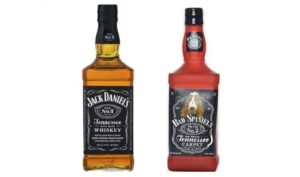
In 2014, Jack Daniel’s challenged VIP’s squeaky dog toy modeled on the distinctive Jack Daniel’s Old No. 7 Tennessee Whiskey bottle, replacing existing text with scatological jokes. “Jack Daniel’s” became “Bad Spaniels,” “Old No. 7” became “The Old No. 2 On Your Tennessee Carpet,” and the bottle’s alcohol-content language was replaced with phrases including “43% POO BY VOL.” and “100% SMELLY.” toy constitutes both trademark infringement and dilution by tarnishment.
In 2018, the U.S. District Court found that the Bad Spaniels toy infringed and tarnished Jack Daniel’s trademarks and entered a permanent injunction against VIP. The Ninth Circuit reversed, finding that VIP’s dog toy is an expressive work entitled to First Amendment protection and that the parodic message qualified as noncommercial use. In 2023, a unanimous Supreme Court rejected both holdings (see our prior article on that decision here). Critically, the Court left the merits—specifically the likelihood of confusion and likelihood of tarnishment issues—to the lower courts.
On remand, the district court found no likelihood of confusion, so VIP won on infringement. But the court held VIP liable for dilution by tarnishment and entered a second permanent injunction. VIP appealed that ruling, and the Ninth Circuit has now reversed it.
The Ninth Circuit’s Decision
Fame Must Be Proven for Each Asserted Mark
While the district court treated Jack Daniel’s marks and trade dress as a collective whole, the Ninth Circuit held that the dilution statute does not permit borrowing the fame of one mark to establish the fame of another. Applying the statutory factors individually, the court found that Jack Daniel’s had proven fame only for the “Jack Daniel’s” word mark and its registered trade dress. Because “Old No. 7” was not separately shown to be famous, the “Old No. 2” joke dropped out of the analysis. “43% Poo by Vol.” likewise had no famous counterpart, because Jack Daniel’s alcohol content language does not function as a trademark. The toy’s most provocative elements thus fell out of the case on a failure of proof.
Generalized Expert Testimony Was Not Enough
The Ninth Circuit also rejected Jack Daniel’s expert evidence as insufficient to establish reputational harm. Jack Daniel’s relied on associative-network testimony that linking a beverage to defecation creates consumer disgust. The court found this insufficient: the expert studied no consumer reaction to Bad Spaniels itself, and the record did not establish that a scatological joke on a pet toy affects consumers the way the same joke would on something people drink.
Parody Still Matters After the Supreme Court’s Decision
The Supreme Court’s 2023 ruling made clear that parody does not trigger the statutory noncommercial use exclusion when the parodist uses the mark as a source identifier. It did not, however, rule that parody is irrelevant to the dilution analysis—and the Ninth Circuit found it relevant here.
A successful parody signals both that it evokes the original and that it plainly is not the original. This distinction can reduce the likelihood that consumers will perceive the parody as damaging the reputation of the famous mark. In the Ninth Circuit’s view, the failure of Jack Daniel’s expert to account for Bad Spaniels’ obvious parodic character was a significant flaw in the tarnishment analysis.
What This Means for Brand Owners
For brand owners, the decision offers useful guidance for protecting and defending intellectual property.
- Register the secondary elements, and use them as marks. Alcohol-content language failed because it isn’t a trademark and never functioned as one. Where a label element is doing brand work—a numbered designation, a signature phrase, an estate name—register it and use it consistently as a source identifier rather than as decoration.
- Understand and address the parodic element. Where a parody is at issue, assess whether the accused use reads as a legible parody, and whether the fame record supports the specific elements copied, before committing to litigation.
- Decide whether dilution is the right claim before you send the letter. Is the specific element being copied independently famous, and do we have or can we get product-specific evidence of harm? If either answer is no, dilution is the weaker claim, and the case belongs on confusion or on a negotiated resolution.